Moebius drew entire universes, and I’ve got some of them on my shelf
Right, let’s get something straight from the off: Jean Giraud — better known as Moebius, or “Gir” when he felt like slumming it drawing cowboys — is easily one of the finest illustrators who ever picked up a pen, and I will hear no arguments. I have several of his books at home, and every single time I open one I find something I’d swear wasn’t there the previous time. It’s not magic, it’s just a man so obscenely talented that his linework apparently keeps evolving between readings.
Where it started (for me, not him)
I used to think Moebius was “that bloke who did the weird French space stuff” and that his western work was the “boring” warm-up act. Then I actually sat down with Blueberry — the series he drew as “Gir” alongside writer Jean-Michel Charlier from 1963 — and had to eat every word. It’s gritty, atmospheric, and real, decades before “gritty” became shorthand for grimdark nonsense. The man could draw a wind-swept face like nobody’s business. What surprised me was how restrained it is compared to his science fiction — proof that his wild imagination was a choice, not a lack of control.
The good stuff, i.e. all of it
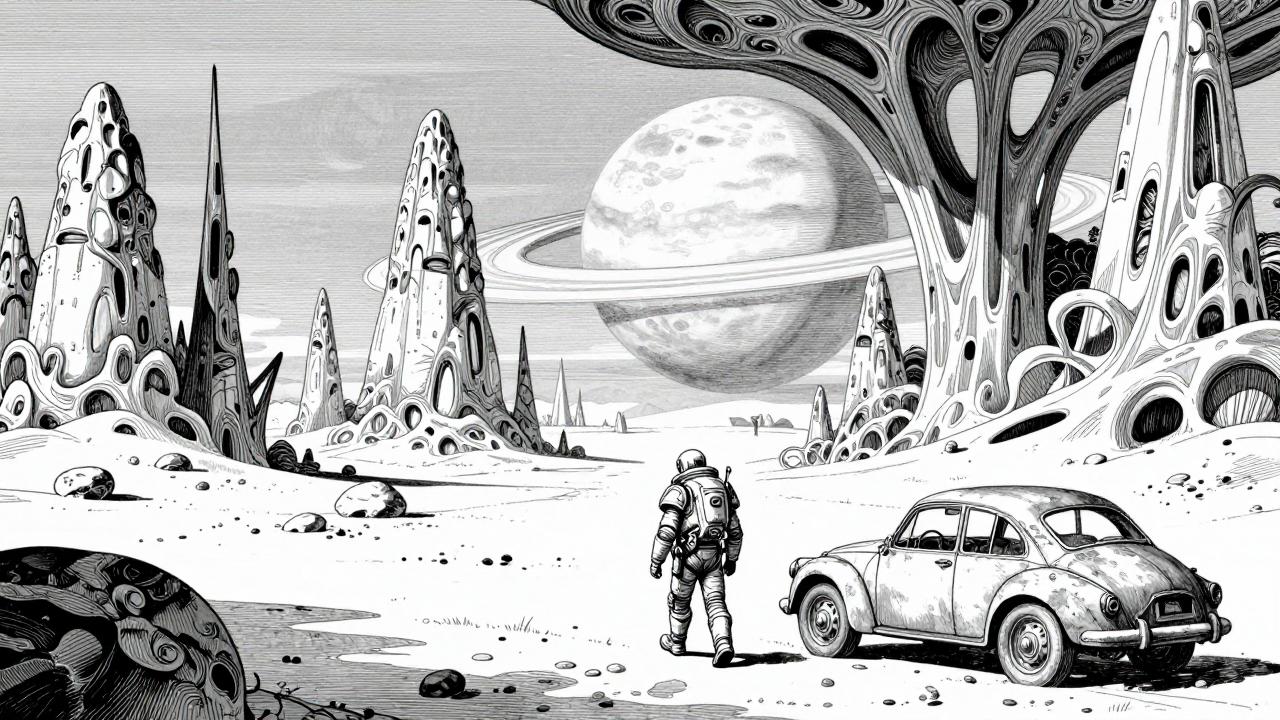
Then there’s the other side of his brain. Arzach (1976) — a wordless saga about a bloke on a flying pterodactyl that manages to say more than most trilogies. Le Garage hermétique (The Airtight Garage) — dreamlike, unhinged, and brilliant. The Long Tomorrow, his noir-parody collaboration with Dan O’Bannon (yes, the bloke from Alien), which basically handed a visual blueprint to half of cyberpunk. And The Incal, his 1981 collaboration with Alejandro Jodorowsky, is still one of the great cosmic lunacies of the ninth art. My personal soft spot is The World of Edena (started 1983), which he wrote and drew himself — it begins as two spacemen and a Citroën and drifts into something quasi-philosophical about dreams and gender. It shouldn’t work. It absolutely does.
Oh, and he drew Silver Surfer: Parable for Marvel in 1988, scripted by Stan Lee. Two issues. Legendary. That’s the kind of flex most artists can only dream about.
The films (because you can’t avoid it, nor should you want to)
Here’s the part that genuinely rewired my appreciation. Moebius’s fingerprints are all over cinema: Alien (1979) — those iconic spacesuits? His. Tron (1982) — that whole luminous digital world? He shaped it. Time Masters with René Laloux, Masters of the Universe, Willow (1988), The Abyss (1989), and Luc Besson’s The Fifth Element (1997) — the flying cars, the cityscape, all of it soaked in Moebius. There’s even Star Wars-connected territory via the ill-fated Jodorowsky Dune project, which, having failed spectacularly, quietly fertilised half of modern sci-fi anyway. Heavy Metal carried his work to the States, and Hollywood came calling shortly after.
This is where I changed my mind about him: I used to file him under “comics artist.” He’s really a world-builder who occasionally took jobs in comics because the pay was nearby. Every time you watch an alien hive, a neon grid, or a taxi weaving through a vertical future, you’re looking at ideas he drafted first.
My humble opinion on Moebius works:
Ten out of ten. Buy the books. If you see an Edena collection going cheap, buy two and send me the spare — no, I’m joking. Mostly. He died in 2012, but unlike a lot of legends, he never stopped drawing, and it shows: the man produced so much that new collections keep surfacing like archaeological finds.
My reading list recommendation if you fancy starting: Blueberry to see the craftsman, The Incal to see the madman, The World of Edena to see the philosopher. Same pair of hands, three completely different brains.
Enjoy!
e.